
Broadleaf vs. Grassy Weeds: Identifying the Spring Invaders in Your North Texas Yard
A Practical Guide to Common DFW Lawn Weeds and the Right Treatment for Each
Walk across almost any DFW lawn in early spring and you will find uninvited guests. Some have broad, flat leaves. Some look almost like grass. Some have already been growing since fall. And here is the thing most homeowners do not realize until it costs them: treating the wrong weed with the wrong product does not just fail. It can damage your turf. At Abracadabra Lawn Pest and Weed Control, our licensed technicians are trained specifically for North Texas soil conditions, turf types, and the seasonal weed pressure that makes our region one of the more challenging lawn environments in the country. Knowing what is growing in your yard, and why it matters which category it falls into, is the first step toward treating it effectively. Here is your guide to the spring invaders most commonly showing up in DFW lawns right now.
Why the Broadleaf vs. Grassy Weed Distinction Matters So Much
The single most important thing to understand about weed control is that broadleaf weeds and grassy weeds do not respond to the same herbicides. The chemistry that kills a dandelion will not touch crabgrass. The treatment that eliminates crabgrass can severely damage or kill St. Augustine and Zoysia if applied incorrectly. Misidentification is the most common reason DIY weed control fails, and it is also the reason a lawn can look worse after treatment than it did before.
Broadleaf weeds have wide, flat leaves with a visible network of branching veins. They are structurally different from grass, which is why selective broadleaf herbicides can target them without harming turf. Grassy weeds, on the other hand, look like grass because they are grass, just unwanted varieties. They grow upright with narrow blades and parallel veins, making them much harder to kill selectively without risking the surrounding lawn. The approach for each category, and for specific species within each, must be matched precisely to the weed and to the turf type it is invading.
Common Broadleaf Weeds in DFW Spring Lawns
Henbit and Chickweed are the broadleaf weeds most DFW homeowners encounter first in spring, because they actually germinated the previous fall and have been growing through winter. By the time the lawn starts greening up, henbit, with its small purple flowers and scalloped leaves, and chickweed, with its tiny white flowers and oval leaves, are already well-established. They are relatively easy to control with post-emergent broadleaf herbicides, but the window closes fast once temperatures rise and they begin to die back naturally. Letting them die on their own is not a strategy because they will have already dropped seeds for next season.
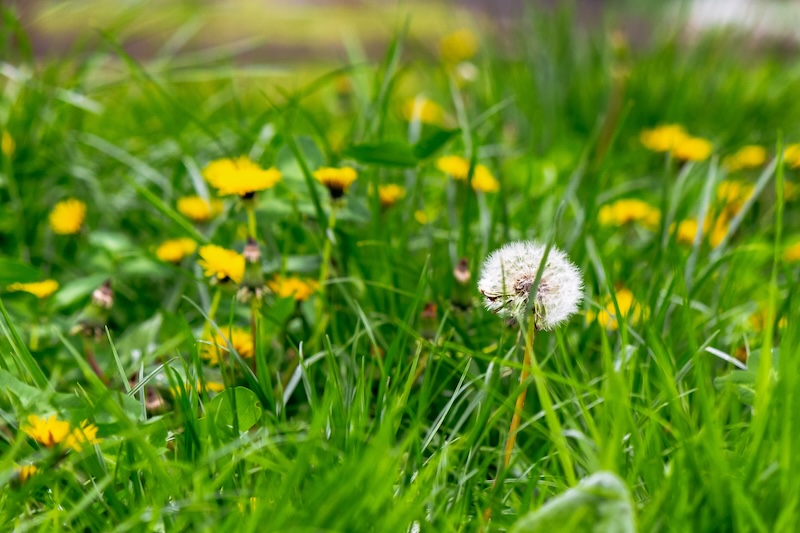
Dandelions are universally recognizable but frequently underestimated. The yellow flower is just the visible part. The taproot goes deep into North Texas clay soil, and surface treatment alone rarely eliminates the plant. Effective dandelion control requires a systemic post-emergent herbicide that travels down into the root, applied when the plant is actively growing.
Clover is another persistent broadleaf invader, identifiable by its three-lobed leaves and occasional white or pink flowers. It thrives in low-nitrogen soil, which means a clover problem is often also a signal that the lawn’s fertility program needs attention. Treating the clover without addressing the underlying nitrogen deficiency typically produces temporary results.
Oxalis (Yellow Woodsorrel) is a broadleaf weed that is commonly mistaken for clover due to its similar three-leaf structure. It spreads aggressively through seed and is notoriously difficult to control with standard broadleaf herbicides, often requiring repeat applications or specialty chemistry depending on the severity of the infestation.
Lawn Burweed is a particular problem for families and pets across Rockwall, Wylie, and surrounding communities. It produces small, spiny seed pods that attach to shoes, paws, and skin. The ideal control window is late winter, before those seed pods form, which is why pre-emergent timing in the fall and a late-winter post-emergent application are both important for keeping burweed under control.
Common Grassy Weeds in DFW Spring Lawns
Crabgrass is the grassy weed that generates the most spring calls across DFW. It is an annual warm-season grassy weed that germinates when soil temperatures hit approximately 55 degrees, spreads aggressively through the heat of summer, and produces thousands of seeds before dying in fall. The most effective crabgrass management is pre-emergent application timed to soil temperature before germination begins. Once crabgrass is established and growing, post-emergent options are limited and vary significantly depending on the turf type being protected. Post-emergent crabgrass control is generally safe on Bermuda but must be approached very carefully on St. Augustine and Zoysia.
Dallisgrass is one of the most frustrating grassy weeds in North Texas because it is a perennial, meaning it does not die off in winter and regrows from the same root system year after year. It forms coarse, clumping patches that are visually distinct from the surrounding turf, with wide, rough-textured blades that stand out clearly in a well-maintained lawn. Dallisgrass has no truly selective post-emergent control option that is safe for all DFW turf types. Management typically involves targeted spot treatments with non-selective herbicide followed by reseeding or resodding the affected area. Abracadabra’s Dallisgrass control program is specifically designed for this challenging weed, which requires a multi-step, season-spanning approach rather than a one-time treatment.
Nutsedge is frequently misidentified as a grassy weed, but it is actually a sedge, meaning it belongs to an entirely different plant family. It is one of the fastest-growing plants in the lawn, often appearing to pop up overnight after rain, and it does not respond to standard grass or broadleaf herbicides. Specialty sedge-specific chemistry is required. Near-lake communities like Heath and Rowlett, where soil moisture tends to stay higher, are particularly susceptible to nutsedge pressure, as it thrives in wet, heavy soils.
Annual Ryegrass is commonly used as a winter overseeding grass but frequently becomes a weed problem in spring when it persists beyond its welcome, competing with the warming-season turf as it tries to green up. In Bermuda lawns especially, winter ryegrass that has not been managed transitions from intentional ground cover to a competitive problem that can delay Bermuda green-up and weaken turf density heading into summer.
Why Identification Comes Before Treatment Every Time
The sequence matters. Spray first, identify later is the approach that produces damaged turf, dead patches, and wasted product. The correct sequence is identify the weed species, confirm the turf type, select the appropriate chemistry, and apply at the right time in the weed’s growth cycle.
That sequence requires knowing what you are looking at, which is where professional evaluation pays for itself. A licensed Abracadabra technician assesses your lawn’s specific weed pressure, turf type, and soil conditions before recommending any treatment program. Our eight-step treatment program is built around this diagnostic approach, applying the right product at the right time for each specific grass type and weed category, not a generic schedule that treats every DFW lawn the same way.
If you are seeing weeds in your yard right now and are not certain what they are or how to treat them, do not guess. Getting it wrong costs more than getting it right the first time.
Ready to Get the Right Treatment on the Right Weeds? Contact Abracadabra Today.
Abracadabra Lawn Pest and Weed Control serves homeowners throughout Wylie, Rockwall, Plano, McKinney, Rowlett, Heath, and the greater DFW area with a proven, professionally timed treatment program backed by a 100% Satisfaction Guarantee. Contact us today for your free lawn evaluation and let us identify exactly what is growing in your yard and exactly how to stop it.